
Markets confidently rose to new highs in 2025, despite a sluggish start and a “tariff tantrum” period in early April. With the Federal Reserve ending its balance sheet reduction in December, the institution has also concluded the largest cycle of quantitative tightening that it has ever undertaken.
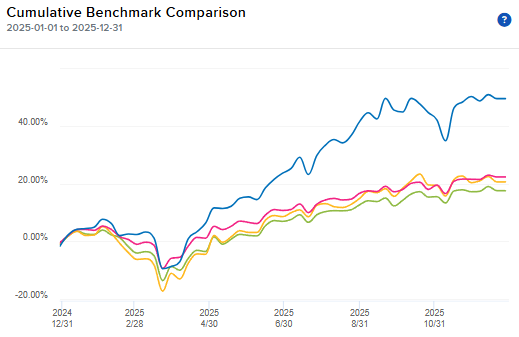

The Numana IBKR portfolio returned 49.7% in 2025, which represented a 32% and 28.9% outperformance when compared to the total return from SPY and QQQ, respectively. The relative performance was improved when compared to the performance gap in 2024 for the same benchmarks.
| Benchmark (TR) | Total Return (2025) | Total Return (2024) |
| Numana (IBKR) | +49.7% | +28.6% |
| SPY | +17.7% | +24.9% |
| QQQ | +20.8% | +25.6% |
| MXWO | +22.5% | +19.2% |
The MSCI World Index, represented by Invesco’s MXWO, has a 7 to 3 ratio in terms of US and ex-US holdings.
As the central banks around the world aggressively lowered policy rates, ex-US companies were able to command higher multiple premiums despite trailing the US companies in terms of revenue and earnings growth. As a result, MXWO was able to slightly outperform SPY in 2025.
| 1/1/2025 | 12/31/2025 | Delta | |||||||
| Long | Short | Net | Long | Short | Net | Long | Short | Net | |
| Austria | 2045 | 0 | 2045 | 0 | 0 | 0 | -2045 | 0 | -2045 |
| Australia | 11916 | 259 | 11657 | 34828 | 1165 | 33663 | 22912 | 906 | 22006 |
| Belgium | 4163 | 0 | 4163 | 0 | 0 | 0 | -4163 | 0 | -4163 |
| Canada | 14917 | 355 | 14562 | 27845 | 7830 | 20015 | 12928 | 7475 | 5454 |
| Switzerland | 18825 | 33293 | -14468 | 10913 | 50165 | -39252 | -7911 | 16872 | -24783 |
| China | 50060 | 285 | 49776 | 37425 | 0 | 37425 | -12635 | -285 | -12351 |
| Germany | 5778 | 0 | 5778 | 3941 | 0 | 3941 | -1836 | 0 | -1836 |
| Denmark | 0 | 0 | 0 | 5088 | 137 | 4952 | 5088 | 137 | 4952 |
| EU | 0 | 23176 | -23176 | 0 | 42974 | -42974 | 0 | 19798 | -19798 |
| France | 0 | 0 | 0 | 6107 | 0 | 6107 | 6107 | 0 | 6107 |
| UK | 39418 | 3331 | 36087 | 26466 | 31 | 26435 | -12951 | -3300 | -9652 |
| Guernsey | 9864 | 0 | 9864 | 9794 | 0 | 9794 | -70 | 0 | -70 |
| Greece | 0 | 0 | 0 | 2808 | 0 | 2808 | 2808 | 0 | 2808 |
| Hong Kong | 21527 | 176 | 21351 | 5658 | 14527 | -8868 | -15869 | 14351 | -30220 |
| Ireland | 2709 | 0 | 2709 | 0 | 0 | 0 | -2709 | 0 | -2709 |
| Jersey | 11388 | 223 | 11164 | 3044 | 0 | 3044 | -8344 | -223 | -8121 |
| Japan | 56020 | 51783 | 4238 | 103840 | 69095 | 34745 | 47820 | 17313 | 30507 |
| Luxembourg | 0 | 0 | 0 | 7391 | 0 | 7391 | 7391 | 0 | 7391 |
| Malaysia | 0 | 0 | 0 | 1660 | 0 | 1660 | 1660 | 0 | 1660 |
| Netherlands | 3514 | 0 | 3514 | 10072 | 0 | 10072 | 6558 | 0 | 6558 |
| Poland | 4175 | 107 | 4069 | 11012 | 2906 | 8106 | 6837 | 2799 | 4038 |
| Singapore | 34746 | 139 | 34607 | 29350 | 0 | 29350 | -5396 | -139 | -5257 |
| Taiwan | 3950 | 0 | 3950 | 3039 | 0 | 3039 | -911 | 0 | -911 |
| US | 144288 | 16254 | 128034 | 367156 | 59140 | 308016 | 222868 | 42886 | 179982 |
| South Africa | 660 | 1 | 659 | 0 | 0 | 0 | -660 | -1 | -659 |
| Total | 439964 | 129381 | 310582 | 707439 | 247969 | 459470 | 267475 | 118588 | 148887 |
1. Some of these companies operate in proxy jurisdictions for tax purposes and the listed country may not reflect the actual operations of the company.
2. The short exposure for ex-US companies are margin balances for that currency, while the short exposure for US companies is a mix of margin balance and short call/put options.
Exposure to the top 10 jurisdictions changed as indicated below.
US : 33% ==> 52%
Japan : 13% ==> 15%
China : 11% ==> 5%
Australia : 3% ==> 5%
Singapore : 8% ==> 4%
Canada : 3% ==> 4%
UK : 9% ==> 4%
Poland : 1% ==> 2%
Switzerland : 4% ==> 2%
Hong Kong : 5% ==> 1%
The portfolio significantly increased its exposure to US companies, while trimming China, Singapore, UK, and Hong Kong positions. Australia and Japan were increased slightly mainly due to relatively strong performance in those jurisdictions.
Gold miners were large contributors to the improved performance, as the portfolio took positions in mid-tier gold miners with active production, such as Equinox Gold, Coeur Mining, and Vault Minerals. Several small positions in junior silver miners such as Investigator Silver and Sun Silver also paid off, along with larger positions in more established resources companies which included BHP and Freeport-McMoRan.
Cryptocurrency ETFs were not invited to the party this year, as Bitcoin and Ethereum returned -6% and -11%, respectively, in 2025. Outsized bets on Bitcoin ETFs along with several Bitcoin and Ethereum treasury companies such as BMNR, ASST, and KULR were ultimately negative contributors to the portfolio.
Another notable point is that the Numana portfolio slowly decreased exposure to the “Magnificent 7” companies, to which the portfolio now only holds Alphabet and Tesla. It was determined that a vertically-integrated stack for future technological advances would likely depend on technology from these two companies.
In terms of energy, the Trump administration has made it a mission to lower energy prices. However, it is likely that the lower prices would affect crude oil more than other forms of energy. Natural gas continues to be a top source of energy production in the US, and while WTI prices fell 20% in 2025, Henry Hub natural gas futures held steady with a 1% gain in the same period. The portfolio held US producers such as Expand Energy, Coterra Energy, and Range Resources, among others, to take advantage of increased LNG exports and tight supply. Uranium companies, which were added to the portfolio through the URA ETF before the start of the calendar year, was decreased significantly due to gains being pulled forward. As natural gas and nuclear energy, along with solar energy, are set to be the dominant sources of energy, any pullbacks in these names will be bought up. With the onset of AI data centers set to increase power demand in excess of 100 GWs, exposure to these energy companies provide not only good capital returns in nominal outcomes but also serve as necessary hedges for possible energy crises.
Many of the fintech (PYPL, XYZ, FISV, etc.) and cybersecurity companies (FTNT, S, ZS) in the portfolio have severly underperformed as they provided negative returns for the year. Although there have been positive exceptions such as CyberArk or Crowdstrike, the continued double-digit growth in these names have only led to compressed price-to-sales multiples despite stable gross margins. Consequently, Numana has slightly increased exposure to these beaten down names but has held back for future opportunities.
Overall, 2025 was a successful year for the Numana portfolio. Past downturns have taught us to take profits when necessary and practice patience with margin balances. As a result, Numana will maintain its policy of maintaining market exposure between 1.1x and 1.5x of net assets.